Wednesday, January 30, 2013

Movie Review: 'Hansel & Gretel'


by Wes King

Yesterday I had the, uh, pleasure to watch Hansel & Gretel: Witch Hunters. Following the trend of half-written, stylized, over violent horror/fantasy whatever-ness that Snow White and The Huntsman, and Abraham Lincoln: Vampire Hunter paved the pathway for, it does nothing to add to the pseudo-genre, except now it’s taken Jeremy Renner down to its dismally low pit.

Hansel is a film so bold, so over the top, so campy and ridiculous, that in twenty years or so, I could see people illegally downloading this film to watch in the same way people today are still watching Sleepaway Camp. If you think that was a compliment, please, click on the red ‘X’ on the top-right corner of your screen, throw your computer out your window, and then bathe yourself in turpentine.

And then set your hair on fire.

And then die. This blog is not responsible for any feelings of self hatred or self harm one may inflict upon one’s self upon reading.

One thing Sleepaway Camp got right that Hansel failed completely was the presence of male nudity. Yup. Even though the nudie bit in Sleepaway Camp was gross and completely ridiculous, I would have been ok if we had a completely ridiculous flash of some hunky Jeremy Renner man-pieces. But, no. Instead we get some random girl ass for a good, solid minute, and in return we see Renner shirtless while hunched over for maybe twenty seconds.

The majority of the movie is over the top action sequences where Hansel and Gretel are beating up a bunch of ridiculously spry old hags with anachronistic guns and doing a bunch of really cool stunts. I probably should have put all that under a spoiler warning because I’m not entirely convinced anything else happened in the film.

Oh yeah, there was some other stuff, kind of like a weak, fermented, moldy condiment on top of the rest of the movie pretending to be some epic plot twist. I predicted it within the first ten minutes.

To conclude, if you know a douche bag, and you really, really, really hate this douche bag, take that douche bag to this movie.

Monday, January 14, 2013

Movie Review: 'Beasts of the Southern Wild'


Score: 5/5
by Brian Kesler

Benh Zeitlin is a newcomer to the directorial world of film, but you wouldn't know it from his beautiful work in 'Beasts of the Southern Wild.' The film is more of a visceral poem than a narrative, really. A film that explores our connection with nature, with each other, and the struggle of all living things to survive.

Our avatar to exploring these concepts is the remarkable Hushpuppy, a five-year-old girl living in a bayou community whose will to survive - emotionally and physically - is remarkable. The performance by the Oscar nominated Quvenzhane Wallis (who breaks a record for youngest nominee ever) strikes a chord in the soul. We follow Hushpuppy as she finds her place in her community, in her family, and in nature. Hushpuppy grabs chickens, crabs, and anything that has blood flowing through its body, puts the animals to her ear, and listens to the mysterious thumping within. She learns from her school teacher how to care for those around her, and she learns from her experiences with her isolated and polarizing father how to take care of herself.

The polar ice caps are melting, and they threaten to flood this swap land and all that live there. Trapped within the ice caps are ancient beasts who once had dominance over all other living things, but went extinct during the ice age. As the ice breaks apart, these beasts float - all the way from the Arctic - to the shores of Hushpuppy's home. As the lands flood, Hushpuppy and her daddy live with a small group of people on a boat. The beasts are released from the ice and roam the wild, looking for humans to consume. The ice that created extinction for so many animals, now threatens the extinction of mankind by melting.

Hushpuppy is a strong little girl. She likes to hear stories of her mama, and arm wrestle with her daddy. She likes to eat with her hands and show off her "guns." She doesn't cry - her daddy won't let her. She has the power to control her own destiny and doesn't put that to waste. She understands the perpetual doom of her own extinction and tries to make an impact on her surroundings, so that one day when "future scientists" are there, they'll know "once there was a Hushpuppy and she lived with her daddy." This culminates in a climactic scene where the ancient beasts charge toward little Hushpuppy, and she stands her ground against them.

Hushpuppy's understanding of life is that it is one giant food chain. She witnesses things being consumed by bigger things, sometimes existentially. She sees her father being consumed by disease and her home being consumed by floods. She understands that in nature, everything has its place, and her place is at the whim of mother earth. If she be consumed by the storm, it's because the storm is higher up on the food chain. As her own extinction looms ever forward, however, she begins trying to survive against the will of nature. When she's confronted by the beasts, she doesn't try to harm them, and they don't try to harm her. They leave each other alone, allowing for their mutual survival and symbolically challenging, perhaps I'm reaching for it here, social Darwinism.

It's always great to try to find some higher purpose for the imagery of a film, but the key to this movie is to just let it pass over you. Like I said, the movie is not so much an intellectual narrative as it is a visceral poem. It floods the soul with feelings drawn out of images and sounds. What does the image of a wild little girl pressing a chicken's heart to her ear say to you? How does that image make you feel? Stanley Kubrick made his entire career out of searching for the perfect composition of images, not to make a statement, but to present an emotion or idea in the most effective way possible. The image of Hushpuppy next to the intimidating, extinct auroch doesn't have to have a higher purpose. What idea does that image present? How does it make you feel? That's the great power of the cinema.

Sunday, January 13, 2013

Movie Review: 'Gangster Squad'


Rating: 2/5
by Brian Kesler

There is nothing special about 'Gangster Squad.' It is cut-and-paste film 101. It follows every genre convention religiously - to the point where it's laughable. In the contemporary world of film, genre conventions are not only passe but looked down upon. You might say the film does this on purpose as an homage to old gangster pictures, and you're probably right. But when Spielberg and Lucas set out to make an homage to 1930s serial adventures with 'Raiders of the Lost Ark,' they broke new ground and took significant risks. They also knew how to film an action sequence. This movie takes no risks whatsoever, which makes for bland movie-going.

Set in 1940s Los Angeles, Gangster Squad follows a band of rogue police men who take it upon themselves to capture the most ruthless criminal in town, Mickey Cohen (Sean Pean). The good guys blow things up and walk toward the camera as flames bloom behind them. Their chief, played with much solemnity by Josh Brolin, gives standard "we're going in" speeches. Penn, as the hotheaded, Jewish kingpin, spends his time eating Lobster and mugging at cops in between his repeatedly dark metaphors and dangerous puns (when he tells a henchman, "You know the drill," the henchman literally pulls out an electric drill and drives it through a man's skull... clever... [note the sarcasm]). All of the puns and metaphors come complete with booming, dissonant chords for underscore. That's how you know his dialogue is really scary.

Of course, no Gangster film would be complete without a bombshell. The bombshell in this case is a red head, played by the beautiful Emma Stone. She is the property of the evil Cohen, but falls in love with one of the rogue cops - played by Ryan Gosling. Their plot is the most interesting if only for the tinge of development that these two actors manage to pull out of a less-than-generous screenplay. Gosling gives the best performance in the film, and it is of his own doing and not of the director's. If only the relationship between these two was given more room for exploration there might have been something beautiful between them.

Again, as with many recent films, this movie argues for vigilantism and bringing criminals to "justice" outside the boundaries of the law. Again, I will withhold criticizing the film for doing so, and merely reflect on it. There is a thirty second stretch of dialogue in which one character asks if the rogue police men are "doing the right thing." On second thought, I will criticize the film on the subject. If this thirty second piece of dialogue had been expanded as a major theme of the film, it would've had twice as much depth. But the movie doesn't explore it. The movie also never explores the implications of gun violence.

The debate is raging around us and it is evident that gun violence in Hollywood is glorified. But does it have a role in developing violent actions in people? I'd like to say no, but it still perturbs me the way in which guns are featured in the movies. Back in the '30s and '40s, any gun violence in a film had to be perpetrated by a bad guy and the bad guy then had to be brought to justice. Usually, this meant that the bad guy lets things get so out of control that it eventually leads to his own death. This was in the days of movie censorship. Of course, that is terribly one dimensional, and a good filmmaker will want to address thematic issues in complex light.

When censorship ended and the MPAA took over, there was a huge surge in anti-hero movies. 'Butch Cassidy and the Sundance Kid,' 'Bonnie and Clyde,' 'Taxi Driver,' and 'The Godfather,' were all big Hollywood hits in which the protagonists were not virtuous, but villainous. It is worth noting, however, that their acts were given different perspective then the movie characters of today's filmmaking. Consider in 'Gangster Squad,' that every time someone shoots somebody else or pulls out a gun, it is filmed in a manner to make the audience think it is "cool." We see the results of violent acts long enough to get a thrill out of it, and then we are spared having to acknowledge that lives really do end when a bullet goes through someone's skull. There is no underlying theme pertaining to guns or the violence they are capable of.

As a comparative example: While people have claimed 'Taxi Driver' was responsible for the assassination attempt of President Reagan, it's very important to realize that director Martin Scorsese does not glorify the guns when anti-hero Travis Bickle purchases them, practices with them, or uses them. When he buys them, Scorsese pays special attention to the unsettling dialogue and focuses the camera on DeNiro's face. There is no music; there are no slick sound effects. When he is practicing with targets and finding ways to hide the weapons, Scorsese sets images of DeNiro's troubled eyes against Bernard Hermann's unhinging score. We then see the unwinding of Travis's mind in the famous "You talkin' to me?" scene (which has more character development in two minutes than 'Gangster Squad' has in two hours). And when Travis finally uses these destructive weapons, Scorsese lets us see and hear the results of his brutality with steady shots and zero musical score, so that we are forced to live the experience as it might actually happen. Scorsese then subjects us to a painfully slow overhead, panning shot (think Hitchcock) that forces us to look at the bloody trail of one man's arsenal. By the end of 'Taxi Driver,' Travis is treated as a hero, a vigilante who freed an underage prostitute from the grips of her pimp. But having been on the journey with Travis, we have to wonder if it's really a simple matter of heroism. This is a man who craves solitude, who is unable to connect with humanity, who constantly sees sin around him and yet can't help his cravings to go to pornographic movie theatres. He does kill the pimps and rescue the prostitute, but only after having a mental breakdown and failing to kill a prominent presidential candidate. Scorsese's last shot is of Bickle's eyes through the rear view mirror. Travis glances into the mirror, directly into the camera, for a brief moment and there is a skip in the music. We are left to wonder what chaos Travis is capable of and/or will commit in the future. That's how violence used to be portrayed in movies: with complexity. Likewise, in 'The Godfather,' we still get the sense that Michael is doing wrong, even as our protagonist. Coppola doesn't just show him killing people, he does it juxtaposed to the baptism of his newborn nephew. That's filmmaking. Not this junk.

Tuesday, January 8, 2013

How I Sorta Popped My 'Godfather: Part II' Cherry

by Wes King

I really hate that this will be the first review I do on this blog. Not because I disliked The Godfather: Part II, but because I was so incredibly exhausted that my mind could not focus on its intelligent dialogue and steady pace.  While I was hoping for my Godfather: Part II cherry to be popped, it would seem my exhaustion thickened my movie-viewing hymen and my cherry was simply poked repeatedly. With that lovely image out of the way, let me get on with some of the great things I did notice, despite my fatigued state.

The Godfather: Part II is brilliantly shot and scripted. The dialogue is essential, as it makes up most of the film, and the framing of the film is simply wonderful. It truly deserves much more attention than my tired mind could supply. The film is genre-defining for “gangster films” yet no comparable gangster film has been seen for decades. It is violent without resorting to over-the-top car chases, shoot outs, explosions, half-naked screaming ladies, or buckets of blood drenching the shot. Instead, the violence in The Godfather: Part II (and its predecessor) is executed straightforwardly in a brisk, swift manner. This form of execution creates a somewhat morbid reverence and honesty, without glorifying the despicable acts portrayed.

The two intertwining stories of The Godfather: Part II—that of Vito Corleone and his son, Michael—serve as both a contrast and a comparison of the two “Godfather” characters, and it is stunning to watch unfold. I am hesitant to say much more, as I believe I am in great need to re-watch the film in a more stable frame of mind.

The Godfather: Part II is a great film, that I am glad I was able to view, and I can’t wait to spend the time watching it again. However, next time I plan to delve myself into its dense plot and give it the proper viewing it deserves.  However, next time I plan for my cherry to explode so marvelously that I’ll be cleaning it up for days.

Sunday, January 6, 2013

Movie Review: 'Django Unchained'

by Brian Kesler

4/5 stars

Tarantino's latest film, 'Django Unchained,' follows a freed slave and his German sidekick as they prowl the southland and shoot, stab, kill, and bloody up arrogant white plantation owners. They do so to the especially nasty slavers. Some of them feed their slaves to ravenous dogs, force them to wear chains, lash them 'til they bleed, and treat slave women as prostitutes. Some of the slaves win favor with the plantation owners and help them carry out their cruel deeds. These men and women, too, are brutally killed by Django and Schultz. It's sort of a Western, except in the South. If the plot sounds like another Tarantino film, 'Inglorious Basterds,' that's because they are the same concept in different historical and racial perspectives.

There's a certain unnerving enjoyment in seeing these slave owners get what they deserve, just as there was an enjoyment in seeing Hitler's body machine-gunned until it was barely recognizable in 'Inglorious Basterds.' This film is not as good as 'Inglorious Basterds.' There was a level of sophistication and unparalleled filmmaking in that movie. 'Basterds' had long stretches of dialogue that triggered suspense, rather than action. The characters in that movie were more interesting, the dialogue unsurpassed, the pace genius, and the plot tight. It was also less violent. Probably not in its visual representation of violence, but in its thematic use of violence, yes. This film has a far more serious and disturbing plot. It gets up close and personal with the real, historical, and painful toils black Americans suffered in the pre-war South. It is therefore, unenlightening - and distracting - when the film resorts to a Hollywood shoot-em-up climax.

This film also follows a cultural trend that concerns me. As I've said in a previous post, violence in film is sometimes necessary and artistic - even in copious amounts - as long as it serves a purpose to the thematic arc of the plot. This film qualifies. But, it's what it has to say about violence that irks me. An ideological tidal wave has struck America in the form of Libertarianism. While there are worthy elements from this ideology, just as with any other, extremism is easy to come by. With all the superhero films, and comic book movies making it big at the box office, there is a trending approval of vigilantism among Americans. Part of that trend are movies, like this one (they seem to be growing in numbers each year) which suggest that revenge is the same as justice. In the film, a certain disgusting character regards himself as a Francophile and, in the nature of his infatuation with all things French, names one of his slaves D'Artagnan, whom he forces to fight-to-the-death with other slaves. After witnessing the Francophile torture and kill this slave, Schultz (the German sidekick) asks him whether he thinks Alexander Dumas would approve naming a slave after one of his characters. Dumas was black, you see. Shultz then proceeds to kill the Francophile and he, himself, ends up dying a hero.

I wonder if Schultz had read another work by Dumas: 'The Count of Monte Cristo.' You see, the trend used to show violence in a different light. 'The Count of Monte Cristo,' like 'Django Unchained,' is about revenge. However, the overall thematic statement Alexander Dumas makes in his masterpiece is that revenge is not the same thing as justice; that the attempt at revenge, or the longing for revenge, will eventually destroy not only your own integrity, but everything you're fighting to protect. It is only recently that our culture has given in to Ayn Rand Objectivism and denied that there is any social contract we have with one another. We have a justice system in place. We have a police force to protect us. Vigilantism and revenge are wrong and go against the very definition of a civilized society.

However, I can't hold this against the film. As a lover of art, it is inappropriate for me to interject my own ideological outlook into the work of an artist, who may express something I disagree with, but - nevertheless - does it well. Tarantino's films all have to do with vengeance in some form, and this film follows the theme. It carries over his wonderful dialogue, his eye for composition, and his unparalleled sense of humor. The plot needs tightening up, the film is overlong, and the climax is disappointing - especially when it revolves around a flat character like Broomhilda - but these faults don't diminish the fact that Tarantino is a filmmaker to be reckoned with.


Wednesday, December 26, 2012

Movie Review: Les Miserables

by Brian Kesler

2.5/5 stars

(This review assumes you've seen either the movie or stage show, or read the book, or just know the plot, as I don't explain it any.)

The biggest problem with Tom Hooper's film adaptation of the hit Broadway musical 'Les Miserables,' is that it isn't meant to be a movie. Stage and screen are two wildly different mediums, and this adaptation of 'Les Miserables' is so faithful to the musical that its status as a film is hindered. Fans of the stage production will most likely love it. Movie buffs will most likely be unimpressed. Unfortunately, I'm a movie buff and a fan of the original production, so my insides were confused during the entire thing.

The faults are apparent right from the beginning. The plot has to cover a lot of ground, and the musical accomplishes this through continuous singing. On a stage, the actors occupy the same space, so when a character is seen going from place to place within a matter of seconds, it isn't jarring like it is when we go from shot to shot of the character going from one place to another. The result is that, after the opening number, the first twenty minutes of the film is a giant montage. It seems like it is rushing through the plot, because it is.

While the stage musical effectively utilizes sing-through style to get through the many plot points, there are musical moments that are completely useless to the film. Film is a more intimate medium. On stage, the Bishop must sing to Valjean to establish the importance of such a seemingly insignificant character. On film, where we inhabit a real world and see the characters up close, the priest would have been better established through simple dialogue and shot composition. On stage, it's necessary for Marius and Cosette to sing their affection for one another, and it doesn't seem odd that they do so because they occupy such a large space. On film, when the camera is up close and personal, we can establish this connection - and much more effectively - through the characters simply looking at one another. The song, 'A Heart Full of Love,' becomes completely unnecessary, and if a song in a musical isn't absolutely imperative for the character to sing, it should be axed.

One moment where a character singing is imperative is 'I Dreamed a Dream.' Fantine becomes so broken and downtrodden, that there is no other possible way for her to express this than through song. Anne Hathaway performs this singing soliloquy so gorgeously that there wasn't a dry eye in the theater, including mine. It represents moments of greatness that this film attains. Unfortunately, all of those moments are established by actors and not direction.

Let's get this out of the way: Tom Hooper is not a good director. I know he won an Academy Award for direction. That's because the Academy is stupid. 'The King's Speech' was a phenomenal film. It benefited from a tight screenplay with witty dialogue and impeccable performances. Not Tom Hooper's direction. Here, he doesn't benefit from a tight screenplay or dialogue, and the result is sloppy direction and obvious visual motifs. The opening number of the film is set up like this: Shot of Javert looking down on Valjean; Shot of Valjean looking up at Javert; Shot of some prisoner pulling a rope; Shot of Javert looking down on Valjean; Shot of Valjean looking up at Javert; Shot of some prisoner pulling a rope; Shot of Javert looking down on Valjean; etc. etc. etc. We get it. There is a relationship between Valjean and Javert being established, you don't have to be so obvious about it. Another moment comes during 'Stars' sung by Javert on a high ledge that Javert could easily slip off of. Hooper is sure to film Javert's feet walking along it, about to fall. An obvious foreshadow to Javert's ultimate demise. The song consists of Russell Crowe walking back and forth with the camera following him. Can't we just have an actor standing still during a song? And can't we just allow the camera to remain motionless? 'God on High' is another example. The song could've been effective as a simple prayer over Marius' sleeping body. Instead, Hugh Jackman is directed to walk all over the place as he sings, sapping any intimacy right out of the number.

In 'Les Miserables,' Hooper attempts to bring the musical to a softer, grittier level, but the musical is inherently big, bombastic, sappy, and operatic. It is impossible to do a faithful film adaptation if you want the characters to be anything but one dimensional. Tom Hooper's attempt at dimension is to film every ballad close up and in one shot, and to have the characters cry uncontrollably. There are a lot of ballads in 'Les Miserables,' and they are all filmed in this manner. After the twentieth ballad of a character up close and crying like a crazy person, I just wanted to rip my teeth out. You don't have to contort your face and scrunch your eyes together to make 'On My Own' an emotional song. Towards the end, I was getting impatient. I get it, you all know how to cry on cue, you've been doing it the entire film.

There are also moments when characters actively provide exposition through song. Again, this was a necessity of the musical, not for film. We don't need Valjean to sing to us that he's the mayor of the town. All we need is a shot to establish this. Exposition in film shouldn't appear as though the character is explaining something for the audience's benefit. It happens all too often in this film.

Reading this review, it might seem like I just hated this movie. I didn't, though. The theatre nerd within me was nostalgic and giddy. I would actively become excited at a new use of orchestration or the start of a song I really liked. But, ultimately, I would rather have been watching this on stage. It was not movie material. Had there been no stage show, and the composers began writing this material for a film, the final product would have been vastly different. As it is, however, the filmmakers had to remain faithful to the show to please purists and theatre-heads. Those people will be pleased. Movie people? Not so much.


Sunday, December 23, 2012

Movie Review: 'Life of Pi'

by Brian Kesler 

5/5 stars

WARNING: Spoilers Abound

There are two basic stories about the creation of life. In one, life began with a single celled organism that separated in two. In the other, God created Adam, and from Adam's rib created Eve. They are both true. One story represents the factual truth, but the other provides an emotional connection to the creation of life.

The underlying message of 'Life of Pi' is that, while religious text and belief might be impossibly fantastical, it provides a fuller, more emotional understanding of life and the human spirit. The film accomplishes this through a "plot twist" that may leave some viewers let down. But it is the pivotal moment in understanding the underlying thematic core of the character and his journey of survival.

The film opens with our protagonist revealing the story of how he took on his name: Pi. He took the name after the irrational mathematical number used to measure the distance in a circle. The number has so many decimal places that it is nearly impossible for the human mind to comprehend, which is why the number is represented by a symbol and often shortened to a comprehensible three digits. This sets the story up, symbolically, and foreshadows the nature of the story we are about to see.

Pi and his family are traveling from their native India, where they owned and operated a zoo, to Canada, with many of the zoo animals on board for sale in America. A storm hits and the boat sinks, killing Pi's family, and the entire crew of the ship. The only surviving members are Pi and a few of the zoo animals, who congregate on a life boat. The animals include a zebra, an orangutang, and a hyena. Pi witnesses the hyena attack and kill the zebra and, eventually, the orangutang. Then, suddenly, a tiger emerges from a clandestine section of the life boat and kills the hyena. The rest of the film involves Pi struggling for survival in the middle of the Pacific and setting up territorial dominance over the tiger, eventually leading to peace between the two.

With the wrong director, this film could have been a bombastic blockbuster with no soul, but the poetic quietude of Ang Lee gives the film an emotional current which propels the adventures of Pi and his tiger, whose name is Richard Parker, to a more substantial level. The visual impact of the film is truly wondrous. Since the 1960s, color in film has not been a major factor in story development, but with the influence of Pixar, and their invention of the color script, the use of color in film has become a distinguishing factor in the filmmaking trends of the new decade. Color is used here to heighten Pi's journey and to establish important plot developments. It's also just awesome to look at. The isolation of Pi and the dynamic between he and Richard Parker are represented by the merging mirror reflection of sky and sea.

This reflection is symbolically important. When Pi finally reaches the Mexican shore and recovers, he is asked to recount his journey. His story is met with skepticism and disapproval, and he is pressured to tell the "truth." Pi, then, tells another story - one in which some of the crew members of the ship, and his mother, were on the life boat with him and horrors ensued. From Ang's directorial directness, we know that this new story is actually what happened, and that the story we've invested ourselves in was only invented by Pi as a way to overcome the harsh realities of his actual journey - just like the number 3.14 is represented by a symbol as the complexity of the number surpasses human comprehension. In the context of understanding the reality of what happened, the tiger represents a dimension of Pi's character: his anger, his impatience, his animalistic simplicity. These are all things Pi must overcome. To survive, he must discipline himself and learn to control his emotional insecurity. This is represented by Pi's efforts to tame Richard Parker.

By the end of the film, an adult Pi asks a listener, whom he had conveyed both stories, which one he preferred. The listener draws parallels between the two stories and, after a thought, firmly confirms that he prefers the story with the tiger. It is important to note that Pi regards both stories as the truth. One is the factual truth, while the other is the thematic truth. Just like the story of the creation of life, we are more emotionally invested in the thematic truth, because of the parallels and underlying symbolism. 'Life of Pi' is one of the best films of the year.

Saturday, September 1, 2012

Movie Reviews: Nine Random Samplings of the Summer

by Jack Garcia

So, I haven't written a review since June 14th.  Luckily Brian reviewed some of the bigger summer movies like The Amazing Spiderman, The Dark Knight Rises and Brave on July 22nd.  But I've been really lazy.  And there were so many movies that I wanted to see and never got around to seeing.  Like Magic Mike.  What kind of a gay man am I if I missed Magic Mike?  Oh well.  There's always Red Box and the privacy of my own home.

And remember, I'm not Brian.  He uses the star system like a legit movie critic.  I'm just a nobody so I rate on an awful, average, admirable and awesome scale.  I also like alliteration.

Rock of Ages AVERAGE

Julianne Hough stars in the screen adaptation of the hit Broadway musical of the same name.  The story is nothing to shout about.  A small town girl takes a bus to Los Angeles because she wants to be a big star, but winds up instead as a waitress in a cool bar where she finds love.  Remind anyone of Christina Aguilera's Burlesque?  Luckily the movie is funny enough to get you through it and most of the 80s rock covers are pretty entertaining (although I'm not the biggest fan of Hough's thin voice).  Also Tom Cruise shows up as the legendary rocker Stacee Jaxx and ultimately steals the show.  Who knew he could sing?

Seeking a Friend for the End of the World ADMIRABLE

I really liked this movie!  There were just a few parts that I didn't think fit in with the whole, or else I would have rated this one "awesome."  Steve Carell plays Dodge, a man whose wife runs out on him when it's announced that the end of the world is near.  He soon meets Penny (Keira Knightley), a much younger woman, and the two embark on a strange apocalyptic journey to say goodbye to their families.  The film is a lighthearted look at humanity and even on the brink of extinction there are a lot of laughs.  But the film also manages to connect on deeper levels and the ending had me in tears.  Kudos to Lorene Scafaria who both wrote and directed.

Ted ADMIRABLE

From Seth MacFarlane, the creator of Family Guy, comes a movie about a little boy and his magical, talking teddy bear, Ted (Seth MacFarlane himself). Except for now they've both grown up and the novelty has kind of worn off.  John (Mark Wahlberg) is the grown-up man-boy and his girlfriend, Lori (Mila Kunis), wants the relationship to get more serious but Ted just keeps getting in the way.  The jokes are all funny with a comedic style perfectly in league with Family Guy, and while I was completely in stitches over the crude, off-color gags, I also found myself attached to the furry CGI character enough to be genuinely sad at the prospect of his demise.  I kinda wanna wish for a talking teddy bear now... oh, and a visit from Flash Gordon.

Savages AVERAGE

Directed by Oliver Stone, the movie stars Blake Lively as O, a woman in love with two men who are deeply involved in the drug trade of California.  Yes, I said drugs.  Lots of marijuana smoking.  And yes, I said she's in love with two men:  Chon (Taylor Kitsch), the strong ex-soldier and Ben (Aaron Johnson), the sensitive hippie-type.  And let me tell you, the scenes with the three of them are smoking hot!  The rest of the film involves another drug cartel from Mexico--led by the villainous Elena (Salma Hayek)--trying to move in on them.  Things get crazy and violent, but mostly the film is a lot of style and a little substance.  Oh, and there's a horrible fake-out at the end.  Trust me.  You'll be annoyed.

Diary of a Wimpy Kid: Dog Days AWFUL

The popular books are back on the big screen, and the result gets worse each time.  Wimpy Greg Heffley (Zachary Gordon) wants to play video games all summer but his dad (Steve Zahn) wants him to get outdoors and his mom (Rachael Harris) wants him to read classic novels.  So what does he do?  He hangs out with his tubby pal Rowley (Robert Capron) at the country club where of course embarrassing and outrageous scenarios play out.  These things are meant to be funny, but mostly they just gave me a headache.  The story meanders all over the place without any sense of purpose and the dog mentioned in the movie title is hardly significant at all.

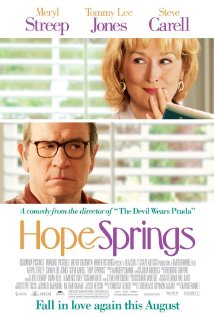
Hope Springs ADMIRABLE

Meryl Streep plays Kay, an older woman, who feels like her husband, Arnold (Tommy Lee Jones), is growing distant.  He no longer sleeps in the same bedroom and she's longing for intimacy.  She convinces him to go with her to a week-long couple's retreat in Maine to undergo therapy with Dr. Feld (Steve Carell).  The performances by the three main characters are very controlled and nuanced and the film has a very intimate feel as we watch them struggle in their counseling sessions.  Sometimes it feels almost too personal.  Like we're intruding.  Still, there are moments of humor and something very beautiful about watching them learn to love again.  My only real complaint is that the soundtrack was cluttered with out-of-place girly pop music, as if this were a feminine hygiene commercial.

ParaNorman AWESOME!

Norman (Kodi Smit-McPhee) is a boy who talks to ghosts.  Or rather, they talk to him whether he likes it or not and the kids in school make fun of him for it.  His parents don't get him either.  But when a witch unleashes a terrible curse--bringing zombies up out of the ground--it's up to Norman to save the day along with his sister (Anna Kendrick), his new friend (Tucker Albrizzi), the school bully (Christopher Mintz-Plasse) and a high school jock (Casey Affleck).  The story deals at its core with issues of bullying and acceptance... and it's not just Norman who's misunderstood.  There is some very gutsy storytelling, fantastic stop-animation, plenty of horror movie references and the end had me in tears.  I loved it!

Lawless ADMIRABLE

The Bondurant Brothers--Jack (Shia LaBeouf), Forrest (Tom Hardy) and Howard (Jason Clarke)--are bootleggers believed to be immortal in their small town in prohibition-era Virginia.  But everything changes when a new deputy (Guy Pearce) moves into town and tries to take control.  Jessica Chastain plays Maggie, a quiet city girl who finds solace in the equally stoic Forrest and Mia Wasikowska plays Bertha, the daughter of a preacher who young Jack falls in love with.  LaBeouf does a fantastic job with his role, imbuing Jack with both an innocence and ambition which causes him to want more than he can handle.  The film is very violent, which I don't necessarily mind, but it becomes almost nonstop and loses some of its ability to be truly affecting.  Still, a good movie with solid performances.

The Possession AVERAGE

Sure, this ain't The Exorcist, but I quite enjoyed watching this movie.  Newly divorced Clyde (Jeffrey Dean Morgan) and Stephanie (Kyra Sedgwick) are trying to make the transition easy on their two daughters, Hannah (Madison Davenport) and Em (Natasha Calis).  But when Em buys a mysterious box from a yard sale, she unknowingly releases a demon who begins to possess her body.  The look of the film is very sleek, with good camerawork, effects, and interesting abrupt cuts, however, some of the performances aren't quite up to snuff and most of the film follows the horror formula to a tee.  Overall though I thought the tension built to a pretty satisfying climax with fun scares and even some humor along the way.  Come to think of it, I've never seen a Jewish exorcism before...

Friday, August 31, 2012

Making the Case that Disney is Liberal

by BRIAN KESLER

People tend to like Disney and Pixar movies. Both studios promote family-friendly, high quality entertainment. I view both Disney and Pixar films, in general, to be works of art - like any other film. And like any other work of art, they usually have strong (or sometimes subtle) social commentary. I never rate a film based on its political ideologies. 'The Dark Knight Rises' is a harsh repudiation of far left radicalism, whereas 'Spirited Away' is skeptical of capitalism and saddened by people's impact on the environment. I love both movies. But, it is fun and thought provoking to evaluate the implications of films. Now, while I think you could make the case that Disney has traces of conservative propaganda (feminists especially like to think so), I don't think it's out of the ordinary to suggest that - as a whole - Disney promotes and encourages liberal ideologies. Starting with:


Animals and Nature

'Bambi' is a perfect place to start. 'Bambi' is an animal rights activist's and conservationist's wet dream. The villain in 'Bambi' (named one of the all time greatest villains by AFI) is ... man. Yup. The entire human race is the bad guy in 'Bambi.' You never see or hear man, because Disney intended to dehumanize us, make us see the consequences of our actions from the point of view of the animals. Bambi's mother is shot by hunters and Bambi is left all alone, defenseless and motherless, and we're left to ponder why anyone would do that to poor Bambi. Obviously, we're supposed to feel sympathy to the animal at this point. But, it isn't only hunting that is chastised. Human impact on the earth is dealt with too. In the final act of 'Bambi,' campers inadvertently start a wildfire that spreads and destroys most of the forest. The fire separates little animal families, kills many of them, and destroys the homes and food supply of the rest.

In 'Wall*E,' which I'll talk about in a later segment as well, human consumption on earth leads to a future of endless piles of filth with no signs of sustainable life. The little trash compacting robot, the only entity left on earth after humans abandon it rather than attempt to make things better, finds the last living plant and through the rest of the movie he protects it as a sacred treasure.

In 'The Little Mermaid,' the chef is seen as a sadist when he gleefully chops off the heads of fish with a clever.

In 'Lady and the Tramp,' the pound is seen as an antagonistic entity. Animals are also seen as more resourceful than humans. When Lady senses a rat in the baby's room, the house sitter punishes her for barking too much. Lady must find a way to escape her chains before the baby gets bitten.

In 'The Lion King,' the opening song is "The Circle of Life," suggesting we are all connected to one another and to the earth.

In 'Pocahontas,' the title characters sings, "How high does the Sycamore grow? If you cut it down, then you'll never know." The Native Americans are seen as having a more nourishing connection with their surroundings, whereas the Englishman chop down trees and raid the land looking for gold.

In 'Dumbo,' mother elephant tries desperately to protect her child and the humans unjustly lock her up and separate her from her infant.

All the Disney princesses are friends with the animals, including birds, deer, squirrels, etc. For instance, Cinderella befriends the mice and her evil stepsisters try to kill them.

In '101 Dalmations,' the villain is the vain, fur-wearing Cruella de Ville, who wants nothing less than a beautiful coat of dog fur.

In 'The Fox and the Hound,' the two animals try to be friends, but because of a hunter's training of the dog, the two become fierce enemies.

In 'Finding Nemo,' the fish in the tank have gone insane with envy of ocean fish, and plot to escape.


Child and Parent Relations

While 'Pinocchio' deals with scaring little children into being good little boys and girls, most Disney movies tend to chastise parents for having too firm a grip on their child.

In 'The Little Mermaid,' Ariel wants to explore the shore and marry Prince Eric. Her father, however, strictly forbids it. He is overprotective and limits her freedoms of who she may or may not love. She must marry a merman. In 'Finding Nemo,' Marlin is overwhelmingly protective of Nemo, and won't let him out of his sight. In both films, the parents' relentless dictation ends up causing their children to rebel, which inevitably makes things worse. Both films end with the parents realizing that if only they let their kids go out into the world and explore and be themselves, the whole thing wouldn't have happened.

In a more drastic version of this story, 'Tangled' shows a mother locking her daughter up in a tower and forcing her to live there her entire life. The mother ends up being the villain and the daughter goes out into the world where the dangers are made up for by the human connections and experiences. The same sort of thing can be seen in 'The Hunchback of Notre Dame,' where the villain is, in fact, Quasimodo's parental guardian, who forces him to stay in the bell tower, hidden from the world. Doing so only advances people's fear of the bell ringer as they come up with all kinds of stories and legends about the unknown man.

In 'Sleeping Beauty,' the prince's father tells his son he cannot see his new girlfriend. The three fairies, likewise, tell Briar Rose she can't see her new suitor. This causes Briar Rose unhappiness and puts her and the Prince in Melificent's snare - where they both get caught. When the three fairies realize that Rose was actually in love with the Prince, they realize that they shouldn't have meddled with the love affair in the first place. They only made things worse.

Parents with an especially firm grip are seen as downright evil. The Stepmother in 'Cinderella' forces the title character to clean and work for her. The inequality in which she treats her children, favoring the other two, causes the stepsisters to become spoiled brats and emotionally damages Cinderella.

In 'Mary Poppins,' Julie Andrews is a nanny who comes to reconcile an estranged father to his children. The father has no imagination, and isn't any fun to be around. He treats his children with an uptight formality, and discourages their wild fancies and eager spirits. Everything revolves around money to him.


Being Yourself and Whatever You Want to Be

In Disney movies, there is a great deal of pretense, and the pretense almost always turns out badly.

In 'Aladdin,' the title character tries to manipulate a girl into liking him, and her father into approving their marriage. This leads to lies and betrayal and the damage is only repaired when Aladdin can be himself. In the end, the Sultan realizes how much he likes the boy and cuts down social barriers by dismissing a conservative law.

In 'Dumbo,' the title character is relentlessly made fun of for his oversized ears. Eventually, he learns to use his assets to his advantage and learns to be happy with who he is. This stresses that people come in all shapes and sizes and we shouldn't put anyone down for it.

In 'Ratatouille,' rather than accept his lot in life, the rat Remmy goes out of his way to be a chef, because it's the only thing he's ever wanted to be. Although people put him down at every turn, he pushes his dream until he changes preconceptions.

There are endless Disney songs which enthusiastically decree that any goal is attainable and that you can be whoever you want to be. 'When You Wish Upon a Star,' 'A Dream is a Wish Your Heart Makes,' 'Part of Your World,' etc.


Consumerism is Bad

In Disney movies, Consumerism and Big Business are generally seen as not good.

In 'Wall*E,' the corporation BnL gets so large that it starts to control the American Government, and eventually the world, until people are living in Fascism. People are told what to buy, what to eat, what colors to like, what things they need for their home, etc. People are unable to think for themselves because of the relentless advertisements that they are constantly attacked with. On top of that, people are totally unaware of their surroundings, they're lazy, and they're generally unintelligent. Consumerism also causes the destruction of the earth. Humans must leave earth because they've burned through every resource in their need to have and buy things all the time. Things are only set right again when the humans eventually decide to let go of their possessions, overtake the brainwashing corporation, and rebuild plant life on earth.

In 'Mary Poppins,' Julie Andrews sings 'Feed the Birds,' which gives the children a choice between investing their money in the bank, as the money hungry big business bankers want, or having charity upon a poor woman in the street selling her wares. When the children decide to feed the birds, it upsets the bankers who manipulate the little boy until he finally gives them his coin - the bankers licking their chops all the while. Only after he gives them his coin does he realize he's been duped, but the bankers refuse to give his money back.

In 'Monster's Inc.,' the Monsters scare children as a source of energy. When some of the monsters start to realize the immorality of getting energy from a child's scream, they are hunted down by their own corporation. It is only when the monsters find alternative sources of energy and the corporate head honcho is revealed to be a liar and scum bag that things are well again.

In 'Beauty and the Beast,' the Beast is punished with a curse because of his vanity, his greed, and his inability to use his money for those less fortunate rather than his own selfishness.

In 'Pocahontas,' as mentioned earlier, the villain wants gold and is willing to rape the land and go to war with the Native Americans in order to get it.


While Feminists have a problem with the portrayal of women in Disney films, it is safe to say that overall, Disney has a liberal ideology. Disney films decry animal cruelty, promote environmentalism, caricature big business, abhor consumerism, chastise parents who are too strict and conservative with their children, and encourage people to go after their dreams and be who they want to be. 


Friday, August 24, 2012

Listmania! Worst Best Picture Winners

by BRIAN KESLER

A friend asked me for my least favorite Best Picture Winners today, and it gave me the idea to do a Listmania! on the subject. There are a lot of bad Best Picture Winners. Not all of them are bad movies, exactly, but most of them are bad choices. Why? Because movies with momentum and popularity at a certain time don't necessarily age well. In fact, I would say they age less gracefully than usual. Why? Because they cater to a specific audiences' wants and needs of a certain era. With almost all of the movies on this list, I am judging the win to be miscalculated due to competition - in fact, I LOVE some of the movies on this list, but they won against better movies. The list is in alphabetical order.


'Around the World in 80 Days' - This cheesy and unfortunate film version of Jules Vern's novel had stiff competition that year. 'Giant,' and 'The Ten Commandments.' Some might also consider 'The King and I' stiff competition, but movies about Christian white women teaching barbaric Buddhist Asians how to be human beings instead of animals aren't really my thing.

'Crash' - A preachy, cliched, and poorly edited film about intolerance won against a groundbreaking and beautifully shot film with pitch perfect performances and one of the best screenplays ever written: 'Brokeback Mountain.' Huge snub. I jumped out of my seat in disbelief when Jack Nicholson announced the winner. The audience mostly did too.

'Dances with Wolves' - A good film, but winning against a masterpiece from Martin Scorsese, 'Goodfellas.' This has gone down as one of the biggest snubs in the history of the Academy.

'The Departed' - After the aforementioned snub, and feeling like Scorsese might die soon and they need to give him an Academy Award sometime, the Academy finally blessed the gifted director for one of his least liked films. Considering 'Letters from Iwo Jima' and 'Little Miss Sunshine' were fellow nominees, this pity win was less than satisfactory.

'Driving Miss Daisy' - This is the most uncontroversial, mellow social commentary on race disparity I have ever seen. This movie is filmed with a rose-colored lens and treats racism like something sweet and nostalgic. Oh, those old people from the south. They're so cute when they're racist. Oh, the old woman learned to love her driver even though he's black. That's sweet. The irony is that Spike Lee's culturally significant and daring, 'Do the Right Thing' wasn't even given a nomination. The other Best Picture nominees, however, make this win even more incredulous. 'Born on the Fourth of July,' 'My Left Foot,' 'Field of Dreams,' and 'Dead Poets Society.' All things considered, this is one of, but not the, worst Best Picture winners in the history of the awards.

'Forest Gump' - I love this movie. I truly do. I love Tom Hanks in this movie. I love the lightness of the film and the fun it pokes at history and the groundbreaking special effects it uses to do so. However, this film went up against 'The Shawshank Redemption.' Oh, and 'Pulp Fiction.' To put it in perspective, 'The Shawshank Redemption' is listed as IMDB's number 1 movie, voted by users. And 'Pulp Fiction'.... need I say more?

'Gentleman's Agreement' - Considering this film went up against David Lean's 'Great Expectations,' and considering that David Lean is one of my favorite directors and Charles Dickens one of my favorite novelists, and considering the two of them combined makes for a happy Brian .... this is a no brainer. Also, 'Miracle on 34th Street.'

'Gigi' - Not that it had stiff competition - 'Cat on a Hot Tin Roof' is a great film, though. I just don't really love 'Gigi.' Not my favorite MGM musical. And old men singing about little girls is just creepy.

'The Greatest Show on Earth' - I'm going to say it. This is the worst Best Picture Winner of them all. Imagine a bloated, 3 hour commercial for the Ringling Bros. Circus staring Jimmy Stewart, Charlton Heston, and Betty Hutton. This is that commercial, directed by the sloppy hand of Cecil B. DeMille, this movie is an abomination that should burn in Hell where it belongs.

'Hamlet' - 'The Red Shoes' has become, in many ways, the ultimate classic. Martin Scorsese praises it as his favorite movie, and people have become dangerously obsessed with the Archers' technicolor masterpiece. It is THE "composed picture" (a movie with the perfect combination of visuals, colors, sound, music, editing, movement, acting, and dialogue). That is why 'Hamlet' seems an odd choice.

'How Green was my Valley' - A sappy and preachy movie that won against 'The Maltese Falcon' and  ... wait for it ..... 'Citizen "FREAKING" Kane'! Yeah, that movie that's deemed the best movie of all time. Orson Welles' visual and character masterpiece that has and will forever haunt movie watchers with its intricate cinematography and dark portrait of the American Dream. That one. It lost.

'Kramer Vs. Kramer' - A good, if not sentimental, movie with demanding performances from Meryl Streep and Dustin Hoffman, 'Kramer Vs. Kramer' took the award against Bob Fosse's final film, 'All that Jazz' and Francis Ford Coppola's daring and astonishing Vietnam War epic, 'Apocalypse Now.'

'A Man for All Seasons' - 'Who's Afraid of Virginia Woolf,' the first film from Mike Nichols, with brilliant photography, a nearly perfect screenplay, and divine performances from Elizabeth Taylor and Richard Burton, was passed up for this good, but somewhat forgettable, film.

'Ordinary People' - I'll admit I've never seen 'Ordinary People,' so it's probably inappropriate for me to suggest that 'Raging Bull' was snubbed. But ... 'Raging Bull' was snubbed. Martin Scorsese's tale of the rise and fall of a boxer's professional and personal life is beautifully photographed and was honored by AFI by being named one of the top ten films of all time. Where was 'Ordinary People' on the top 100 list? Nowhere. Come to think of it, have you ever seen 'Ordinary People' on any Best-of list?

'Out of Africa' - Steven Spielberg's powerful adaptation of Alice Walker's 'The Color Purple,' received eleven nominations and received exactly zero awards. It was an unfortunate snub for the best movie of that year.

'Rocky' - You're shocked, I know. Let me first say that I love 'Rocky,' and that it does fall somewhere on my favorite movies list. However, 'Network' is higher up on that list and 'Taxi Driver' is my favorite Martin Scorsese movie ever made, falls in my top ten ever list, and is the biggest snub of Scorsese's career.

'Shakespeare in Love' - Harvey Weinstein has the system rigged nowadays, and does anything possible to get his films nominated, if not selected as the Best Picture of the Year. There is more in the way of business, politics, and money that selects the winners and less in the way of artistic integrity. 'The Thin Red Line' and 'Saving Private Ryan' are both far superior films. For that matter, so are 'Life is Beautiful' and 'Elizabeth.' There is an audible gasp from the audience at the Oscars ceremony when 'Shakespeare in Love' is announced the winner. It set a new beginning for swindling and campaigning a movie to win. By the way, it is not required for the voters to actually watch the complete list of nominees. What a great system.


Sunday, July 22, 2012

Movie Reviews: 'The Dark Knight Rises'; 'The Amazing Spiderman'; 'Brave'


I've missed a few weeks, so I'm consolidating and posting three reviews today.


'The Dark Knight Rises' 

Rating: 4.5/5

I had to watch 'The Dark Knight Rises' twice before I could feel confident in how many stars to give it. Movie reviews are very objective, particularly the rating. When I first saw the movie I was shocked with how well it lined up with the first film in the trilogy, 'Batman Begins,' rather than continue the psychological darkness of the second film, 'The Dark Knight.' I gave 'The Dark Knight' 5/5 and, in my mind, I couldn't possibly see how I could give this film anything higher than 3.5/5. It had let me down. It wasn't 'The Dark Knight!' When I saw it the second time, however, and gotten over the tie-ins to 'Batman Begins,' I was able to see the film for what it is: A tightly plotted thriller and mystery with a great twist and a remarkable climax. I was ready to give it 5/5 after the second viewing, but there was still the issue of 'The Dark Knight,' which is a masterpiece. So, with the ratings of the two films sitting next to each other, I bumped the rating down to 4.5/5.

The film's timeline is very ambitious. It starts a full eight years from the last movie. The batman no longer exists, Bruce Wayne is a cripple and a shut-in. Gotham has seen nearly eight years of almost no crime due to the Dent Act, which detective James Gordon and the mayor were able to get passed by using the Batman as a scapegoat, suggesting he murdered a "heroic" Harvey Dent. Of course, we know otherwise, but the ends - in Gordon's and Wayne's minds - justify the means.

Of course, good things cannot last, and there is a new threat to Gotham. A bulky man with a Darth Vader-esque mouth piece named Bane and his gang of suicidal terrorists. Bane seems to be working for a man within Wayne enterprises, who in turn hires a young woman with acrobatic skills and a knack for robbery. This is Catwoman, although she is never called that, and may not even call herself that. Her costume is very creative in giving us the clue to her Comic Book association. Catwoman, or Selina Kyle, grew up with nothing and steals only from the wealthy, who she thinks deserve it. In a conversation with Bruce Wayne, she tells him, "There's a storm coming, Mr Wayne. You and your friends better batten down the hatches, because when it hits, you're all gonna wonder how you ever thought you could live so large and leave so little for the rest of us."

Which brings me to the real juice running the plot of the movie. What Selina Kyle was talking about was a revolution. In fact, this movie is - in a way - an allegory of the Occupy Wall Street movement and the perpetual fight against class warfare, which the movie seems to tell us threatens our way of living and the very fabric of America. We see an all-American football field destroyed juxtaposed to the sound of a young boy singing the 'Star Spangled Banner.' We see the police force trapped underground and torn American flags waving in the wind while Bane promises to give power to the people, offering joint ownership of property, no rich or poor. It seems very much like the Russian Revolution of the 20th Century. The rich are beat upon and thrown out of their homes and sentenced to walk across icy water until their weight forces them through. Anarchy and communism and other far left ideologies are seen as the enemy to America. Are we back to media propaganda from the 1950s?

The story, like the other two films, is intricate and tightly molded. By the time the climax rolls along, the audience is amped and ready, and the final ten or fifteen minutes is an edge-of-your-seat experience. My only beef, as I said previously, are the plot connections (and almost continuation) of the first film. I don't want to give away the twist, but I'll just say that the plan of the bad guys is a retread - though not as frightening or imaginative - as the first film. Some people have found this admirable. I find it to be akin to the second Death Star in 'Return of the Jedi.' You couldn't have done something more original?!

There is no touching 'The Dark Knight.' It is a masterpiece with one of the great performances of any actor in the history of the business. But, as I realized, that shouldn't diminish the quality and scope of this film, which is much lighter than both previous films, and enormously entertaining. See this movie. 


'The Amazing Spiderman' 

Rating: 4/5

As I said, ratings are objective. Do I really think this film is that close to being as good as 'The Dark Knight Rises'? No. But, do I think it's better than most comic book movies? Yes. Do I think it is better than the other 'Spiderman' movies? Mostly. Therefore, comparatively, this film gets a 4/5. Unlike 'The Dark Knight Rises,' the plot is not intricate, the characters not complex, and the film unambitious. However, it is fun as hell and gives us the talents of Andrew Garfield and Emma Stone, both tremendously gifted comedians.

You may ask if there was much of a point in rebooting 'Spiderman,' and the answer would be no. It follows the same basic plot of Sam Raimi's first 'Spiderman,' and isn't quite as good as Raimi's second 'Spiderman.' But, the film has its own qualities to make it shine a bit brighter. Raimi used gifted dramatic actors, Toby Maguire and Kirstin Dunst. Director Mark Webb uses comic actors Andrew Garfield and Emma Stone. The tone is considerably lightened. The chemistry between the two is endearing, and the way they play off one another is sharp and uncanny.

Another significant difference is Peter Parker's relationship to his presumed dead father. It gives his character a little more weight than was there previously. The film begins with a prologue involving Parker's father, which is completely unnecessary and diminishes the mystery and lack of knowledge Parker feels about his dad. Something we might have related with had it not been for the prologue.

The Lizard, which is the villain of the film, is uninspired, clunky, and a bit ridiculous. Doc Ock remains the best villain of the 'Spiderman' films, but I'd like to know what it is about the 'Spiderman' universe that makes the villains compelled to have conversations with themselves all the time. It happens in all of them and it's getting on my nerves.

The main reasons to watch this film are for the thrilling action scenes and the chemistry between Garfield and Stone. The film is well photographed and well edited. The action scenes, unlike most movies these days, have clear direction. You can see everything going on and follow it through each cut. Unfortunately, the film is overscored, which removes any weight or tension. But, the brevity supplied by the romantic leads more than makes up for any shortcomings this film may have.


'Brave'

Rating: 3/5

'Brave' is Pixar's most unambitious and traditionally plotted film yet. Which is shocking and sad. I've gotten used to seeing a groundbreaking picture from Pixar every year. Films like 'Toy Story,' 'Monster's Inc.', 'Finding Nemo,' 'Ratatouille,' 'Wall*E,' 'Up,' and 'Toy Story 3,' were not just good movies, they went beyond traditional storytelling to give us unforgettable characters, moving experiences, daunting set pieces, and complex plotting. 'Brave,' however, plays more like a Disney film, and I'm not exactly thrilled with the direction Pixar has been taking the last couple of years - or in the near future.

The film involves a young red-headed Scottish princess, Merida, who wants to ride horses, hunt, fish, and scale cliffs. Her mother wants her to be a proper lady and settle with a husband. And that's, essentially, it. There is a twist I won't divulge, but the twist does little to strengthen the film or add any complexities. I don't think I'll be giving anything away when I tell you that the mother and daughter come to learn from one another and everybody is happy in the end, but the journey they take together is far too sparse and uninspired for them to have learned anything at all. When they get to the necessary part when they see each other's point of view, I don't believe it. I never saw a transition point.

Perhaps the most disappointing aspect of the film is how relatively unadventurous it is. Most of the film takes place indoors, with dark, narrow corridors as a backdrop. When the film takes us outside, it's like a breath of fresh air. But, just as we start taking in the beautifully animated landscapes of Scotland, we're back indoors again, with very little to look at. A lot of the film is nothing but heated conversations which go on far too long and don't accomplish much.

What the film gets right is it's unusual, and often crude, humor. There's a fine line with crude humor in a family film, and Pixar knows exactly where to toe the line and how to keep it from getting out of hand. The foul, filthy, and wildly hot-heated Scottish men are perfect avatars for that sort of humor, as are the three mischievous red-headed little boys. Unfortunately, the humor also goes on too long, with two many brawls between the men, and a very very long sequence in which the little boys trick the men into following them all around castle corridors in pursuit of a bear. These scenes, essentially, reduce Merida's adventure to one or two scenes.

I hope Pixar gets back on track producing groundbreaking films again. With a prequel for 'Monster's Inc.' coming up next year, it doesn't look like it'll be soon.